![]()
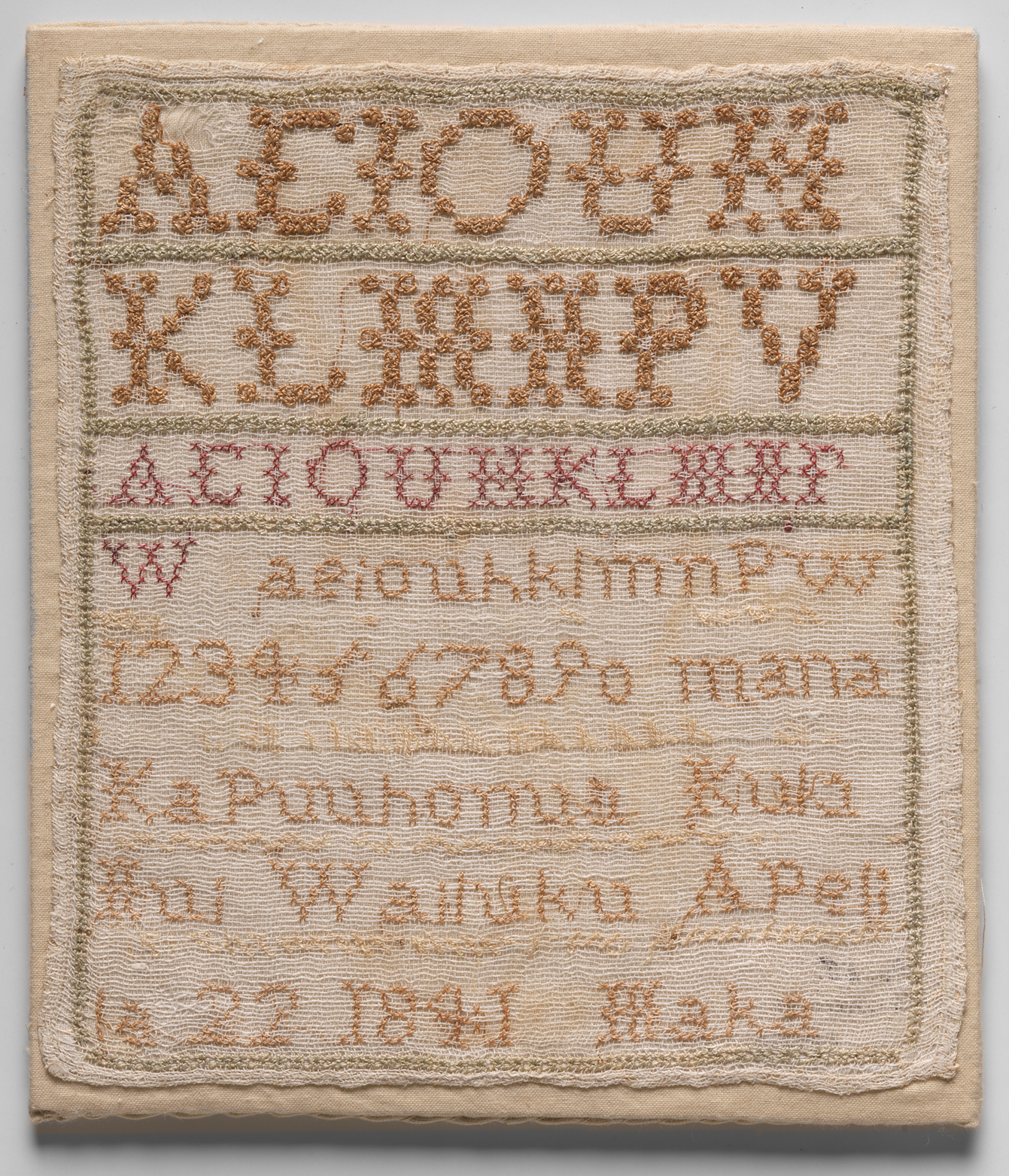
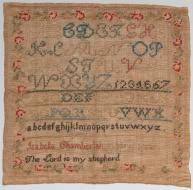
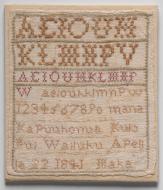
Missionary schools were designed to both convert children to Christianity and indoctrinate them in Euro-American culture. This sampler by “Maka” was made at the Wailuku Female Seminary on the island of Oahu under the direction of teacher Maria Ogden, who also gave instruction in spinning and weaving, quilting, and other textile arts. Ogden arrived on the same boat as Isabella’s mother, and the two were lifelong friends.
Maka’s sampler uses only the letters of the Hawaiian alphabet (the missionaries created a written alphabet of the previously only oral language), and gives her name and date and a Hawaiian phrase which has been translated as “Wailuku, place of refuge.” We know nothing more of Maka; there are two girls in an 1841 list of students whose names could be shortened to Maka, one from near the school and one from another island, but we don’t know which girl made the sampler, nor what happened to them after their school years. Maka’s sampler is one of only three Hawaiian missionary samplers to survive (the other two are in the collection of Historic New England), and we are extremely happy to have this one here at the DAR Museum.
If you would like to learn more, I will be giving a lecture at one of our DAR Museum Tuesday Talks, on April 10 at noon at DAR Headquarters, on the stories of the Hawaiian samplers, their makers, their schools, and the missionaries of Hawaii. If you can’t make it to Headquarters, the Museum lectures are posted online here: www.dar.org/MuseumVideos. You can also search the museum’s database for needleworks and samplers; we are constantly adding new entries for you to enjoy.

 Today's DAR