
 Today's DAR
Visiting the Last Frontier State
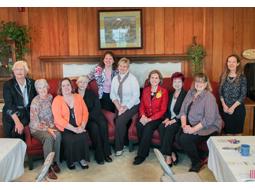
Several years ago my husband and I enjoyed a cruise along the inside passage and I have been eager to return for a visit. My schedule had too many conflicts to attend their spring conference and the Alaska Society does not hold a fall meeting due to their vast size, so State Regent Cindi Gryder suggested a road trip to visit the chapters. Six of us spent the week traveling together - Cindi, her daughter Kim Johnson, Past Vice President General Debbie Refior; State Registrar Michelle Walters-Thornton and State Historian Tracey Dodge. What an adventure it was!
The name "Alaska" is derived from the Aleut word "Alyeska," meaning "great land." Not only is it a vast state, the scenery is spectacular. Alaska has 250 members in five chapters in four cities – Fairbanks near the center of the state, Anchorage near the southwest coast, Kodiak Island and Juneau. I flew from North Dakota on Sunday afternoon, September 14th, arriving in Fairbanks late that night.
Four of the five Alaska Chapters planned a day’s activities for me. The Alaska Chapter started with breakfast at the Cookie Jar (just visualize a huge cinnamon roll fried in French toast batter), followed by a tour of the Fountainhead Antique Auto Museum. The Museum has a world-class collection of restored antique automobiles, including examples of some of the first vehicles brought to Alaska. We enjoyed the period dresses featured along with the automobiles and particularly enjoyed trying on the large hats.
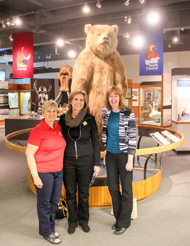 From there we toured the University of Alaska Fairbanks Museum of the North. They have a marvelous collection of artifacts which was highlighted by a presentation by Dr. Andres Lopez, curator, on the Voyages of the R/V Sikuliaq (pronounced see-KOO-lee-auk). This 261-foot oceanographic research ship is capable of bringing scientists to the ice-choked waters of Alaska and the polar regions. It is one of the most advanced university research vessels in the world and will be able to break ice up to 2.5 feet thick.
That afternoon we spent several pleasant hours aboard the Riverboat Discovery. The sternwheeler trip includes a walking tour of a replica of an Interior Alaska village led by Native Alaskans from the region, dog sled exhibition, and a bush pilot demonstration.
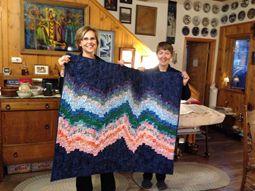 That evening we drove to the home of Linda Mullen, Alaska Chapter member, to dine on a potluck dinner and have an informal visit with the members. Although Chapter Regent Susan Malen was out of the state, I was flabbergasted to receive the beautiful Aurora Borealis quilt she made. Now I can enjoy the Northern Lights in my own home!
State Regent Cindi Gryder has lived in Fairbanks for over 30 years and had a personal gift knitted for me – a Quiviut (pronounced kiv-ee-ute) smoke ring scarf. In the Eskimo language, quiviut is translated as "down" or "underwool". The yarn is made from the finest hair of Artic musk ox and is considered the warmest of all of the animal furs. The scarf is featherweight yet extremely warm. Qiviut is softer than cashmere and is light as a feather. I’m looking forward to wearing it on our Scotland tour week.
Speaking of cold, I was surprised to see electrical cords emerging from the front bumpers of Cindy’s car. She explained that the winter temperatures in Fairbanks can plunge to 50° BELOW and that a car parked outside must be plugged in at night to keep the engine blocks from breaking. Previously, fluids had to be drained from the automobile at night and the battery removed, then the oil, water, transmission fluid and battery had to be replaced the next day.
On Tuesday morning we had breakfast at the home of Alaska Chapter vice regent Jeannie Phillips. We packed picnic lunches and left Fairbanks for Anchorage, a 360 mile trip through Denali National Park. This vast park is six million acres of land, bisected by one two lane highway. There are many hiking trails and on one we spotted a moose. North America’s tallest peak, 20,320’ Mount McKinley, remained hidden by the clouds. In fact, the locals say it is hard to see all of Alaska as half of it is hidden in the clouds. With delays caused by highway construction, we ended a long day at a delicious restaurant in Wasilla (and no, we did not see Sarah Palin).
 On Wednesday morning, the Sleeping Lady Chapter, Molly Jackson, Regent, arranged for a tour of the Native Art Center of the Alaska Native Medical Center. Alaskan Natives come from all over the state for medical care and they have an impressive display in the lobbies of each floor of the medical center. Many of the patients spend months crafting items and bring them to the medical center to place on consignment in one of the best gift shops in the state.
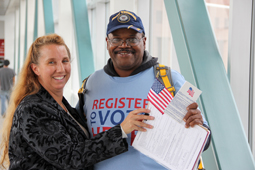
During lunch, Honorary State Regent Donna Hicks gave each of us a copy of the Constitution and a small American flag and challenged us to give them away while explaining the importance of Constitution week. Michelle found a veteran encouraging residents to register to vote and he was delighted to receive the gifts.
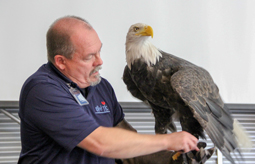 Wednesday afternoon we had a special presentation at the BP Energy Center by the Bird Treatment and Learning Center. The Bird TLC, a nonprofit organization, was begun by Dr. James R. Scott, a veterinarian who closely tended an eagle he named “One Wing”, injured in the Valdez oil spill. Although unable to save the eagle’s wing, he developed such a close bond with One Wing that a book was written about both of them. Bird TLC is dedicated to rehabilitating sick, injured or orphaned wild birds and providing avian education programs to the public. The presenter brought a bald eagle that had been injured almost 20 years ago and is unable to return to the wild. He gave a great deal of information on eagles and other rescued wildlife. I was surprised to learn that Alaskan bald eagles are much larger than their southern counterparts. I was very touched to receive a copy of One Wing and to hear from Donna Hicks about her successful attempt to have the book autographed by Dr. Scott who now suffers from Alzheimers.
That afternoon we drove out to the Matanuska-Susitna (Mat-Su) Valley which has the richest soil in Alaska, left by departing glaciers. With their long days of sunlight in the summer, the flowers and vegetables grow to massive sizes. The Colony in Palmer was started in 1935 to settle the valley and we had dinner in the original dormitory built for the teachers.
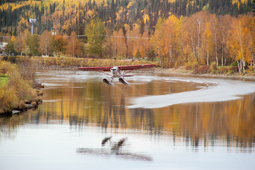 On Thursday, the Col. John Mitchell Chapter had another full day planned. Although it was a rainy day, Chapter Regent Lael Marlow lead the caravan down the Turnagain Arm of Cook Inlet with stops for history and wildlife viewing. It was reportedly named Turnagain Arm when explorer James Cook was disappointed to learn the inlet was not the northwest passage he was seeking and commanded the crew to “turn again.” Lael pointed out Dall Sheep high on the mountain.
Nearby is the Alaska Wildlife Conservation Center where we were safely able to observe bear, musk oxen, caribou, a great horned owl, moose calves and bison. I was tickled to spot a bald eagle sitting in a tree above us.
We drove a short distance to Girdwood for lunch at the rustic Bake Shop, then took the tram to the top of Mount Alyeska for scenic viewing. Through the clouds we could see several hanging glaciers. Imagine our surprise on the way back down the mountain when the tram operator mentioned his sister is a member in D.C.
As we returned to Anchorage, we stopped by two of the DAR historic markers before dropping in on member Carol Ross, who runs a Bed & Breakfast. Carol’s home includes a huge collection of Alaskan artifacts including mastodon tusks.
Dinner that evening was a delicious potluck with the Col. John Mitchell Chapter members at the Anchorage Pioneer Schoolhouse. When the area was first being settled by non-native Alaskans, one of the women urged her husband to build a school. He told her if she wanted a school, she should build it, which she did in 1915. The evening ended with a lovely chorus of the Alaskan State Flag song.
We flew to Kodiak Island late that night where Debbie Refior and her husband, Lyle, hosted us for the evening. Their home is on a canal and the morning sunrise was almost beautiful enough to tempt us to cancel our plans and just admire it. The members of the Natalia Shelikof Chapter, Gerry Knagin, Regent, had planned another full day beginning with a private tour of the Alutiiq Museum Tour www.alutiiqmuseum.org.
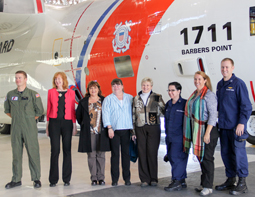 We then toured the U. S. Coast Guard Air Station where we were invited to climb into a C-130 and to hear about the cargo and missions they carry. We also learned about the H 60 and H 65 helicopters and had a presentation from one of their highly trained rescue swimmers. The Coast Guard supports a variety of missions, including medical rescues, commercial and private boating emergencies, as well as Homeland Security concerns.
Other chapter members joined us for lunch at a local restaurant. We were entertained by several generations of Alutiiq dancers. Gerry presented a box of home canned smoked salmon and other goodies and Cindi added to my state charm bracelet with a charm filled with Alaskan gold flakes.
Cindi and I reluctantly said good bye to the Kodiak ladies and returned to Anchorage where I boarded an overnight flight, returning home early Saturday morning.
My only regret is that my travel schedule did not permit a day with the newly organized Inside Passage Chapter in Juneau. Not only was this chapter just organized in April of 2014, they have already contributed 100% to the President General’s Project. It was a wonderful Alaskan Adventure and I thoroughly enjoyed the travels and the opportunity to visit with so many members.