
Next Week's Marian Anderson PBS Documentary Features NSDAR Archives Research

Tracy Robinson, DAR Director of Archives and History

When the documentary “Voice of Freedom” about Marian Anderson airs on the PBS series American Experience on Feb. 15 at 9 p.m. ET (and is afterward available for online streaming), it will include never-before-released information from documents found exclusively within the holdings of the National Society in its growing Marian Anderson Educational Resource collection.

The producer reached out to the NSDAR Archives and History Department early in his research efforts, relating at that time that he wanted the documentary to provide a more in-depth portrayal of the characters involved in the events of 1939, including Sarah Robert, who served as DAR President General from 1938-1941.

When first researching Mrs. Robert, he was intrigued by a 2016 Today’s DAR Blog post describing the DAR’s acquisition of Sarah Robert’s collection of papers. He sought access to the collection in order to learn a more-detailed account of the behind-the-scenes events. Although we had received the collection of more than 40 boxes covering 70 years of Mrs. Robert’s life at the time, NSDAR Archivist Joy O’Donnell had only just begun the process of assessing and organizing the collection, and it would not yet be navigable by an outside researcher for more than a year as it was being prepared. We appreciate the producers' patience in waiting until the materials were organized and ready for research.

We are grateful both to Mrs. Robert for preserving so much of the Society’s history and to her son, Henry M. Robert III, for generously donating the collection to DAR just three years before his passing.

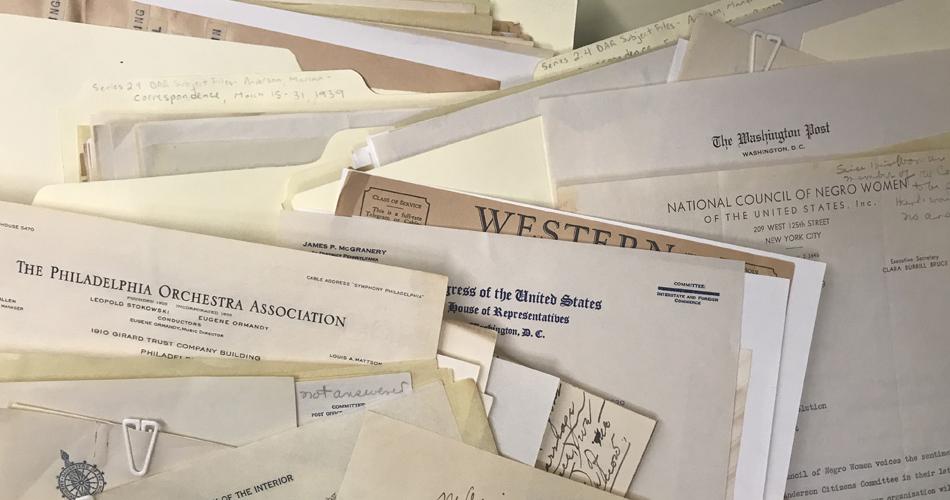
In some publications regarding Marian Anderson, historians have speculated that internal DAR documents such as these were lost to time – but the acquisition of the Sarah Robert papers brought to light many previously unanalyzed primary-source documents from that time period. We were surprised when we found not just some papers related to Marian Anderson, but the equivalent of approximately two full archival boxes of material organized by Sarah Robert herself on the subject. Mrs. Robert intentionally preserved what appears to be most of her correspondence and documents, as a note in her handwriting reads: “Think that all of these should be kept in permanent file – for possible reference in the future.” 

The larger collection sheds light on a variety of important aspects of both Mrs. Robert’s own achievements and the business of the National Society.  A scholar of American history, Mrs. Robert graduated from Syracuse University in 1909 and spent several years teaching history to high school students.  In 1919 she married Henry Martyn Robert, Jr., the son of General Henry Robert, author of Robert’s Rules of Order, the most widely used manual of parliamentary procedure in the United States.  Mrs. Robert became a leading authority on parliamentary procedure, serving not only the DAR as its National Parliamentarian, but also numerous other organizations and individuals in search of parliamentary guidance.  She taught special courses on parliamentary law at Columbia and the University of Maryland and was a trustee of Robert’s Rules of Order. In addition to her active professional life, Mrs. Robert was a member of a number of women’s organizations. She was also involved in her local community of Annapolis, Md., serving as the executive director for Annapolis’ tercentenary celebrations and as a member of both the local historical society and the public library association.

In addition to the vast array of significant documents in Sarah Robert’s collection, it was particularly fascinating to explore the folders related to Marian Anderson. As we researched the material, we realized that we were likely the first people to see these primary source documents in at least 70 or 80 years – and likely only among a very few people who have ever seen them. We recognized the responsibility we had in preserving these historic documents, especially since they had not been previously kept in a professional archival repository.

Considering our organization’s commitment to historic preservation and education, then-President General Ann Dillon recognized that it was important to share this repository with the public, which is in keeping with professional archival ethical obligations regarding transparency and the mission of archivists to make historic documents available for research. As a result, DAR committed to organizing the Sarah Robert papers and other items in our archives related to Marian Anderson in order to create a comprehensive educational resource. The resulting Marian Anderson Resource Guide assembles into one convenient document a list of all Marian Anderson items housed in the NSDAR Archives, including the more recently acquired material from the Sarah Robert papers. The guide provides historical context for the records and furnishes information on provenance, content and navigating the topic for research purposes.  

As the Marian Anderson Resource Guide evolves, we’re discovering that the documents in the collection both confirm details about the Lincoln Memorial concert as outlined by historians and provide more context and nuance to the historical account. The documents provide a window into the time period and while they cover difficult topics, they also shed light on complexities that cannot always be done justice when telling the story in a single soundbite, book or documentary.

When the “Voice of Freedom” was in research and production last year, President General Denise VanBuren gave permission for representatives from the production team to conduct research in the NSDAR Archives with assistance from our archivists and an early draft of the Marian Anderson Resource Guide. The documentary researchers noted that the Sarah Robert papers provided a wealth of information that gave them better appreciation for the challenges faced by all involved during the time period, and so we hope the collection aided the research for the new documentary.

Another historian and scholar, Dr. Carol Oja, professor in the Harvard University Department of Music, also researched the new collection in its early stage of archival processing and published a piece about her research in the Times Literary Supplement in July 2020 (read here). Excerpts from the conclusion of her article read: “Opening up Sarah Corbin Robert’s archive to scholars constitutes a major step toward transparency, even reconciliation… It is one model for other institutions with a similarly troubled past.”

The upcoming “Voice of Freedom” documentary received permission from the National Society to use images and documents from the NSDAR Archives, in addition to interviewing President General VanBuren. This is the first time that most of these materials have been made available to a larger audience.

As we continue to organize and consolidate the materials related to Marian Anderson in our NSDAR Archives, please view a sampling of some of the documents in this online exhibit. The Marian Anderson Archival Project is an ambitious effort that will continue for many years. We take inspiration from the Marian Anderson Collection at the University of Pennsylvania and hope to develop an educational resource that complements and expands on other historical research material related to the 1939 concert.


Additional Information

send-a-commentSend Us a comment