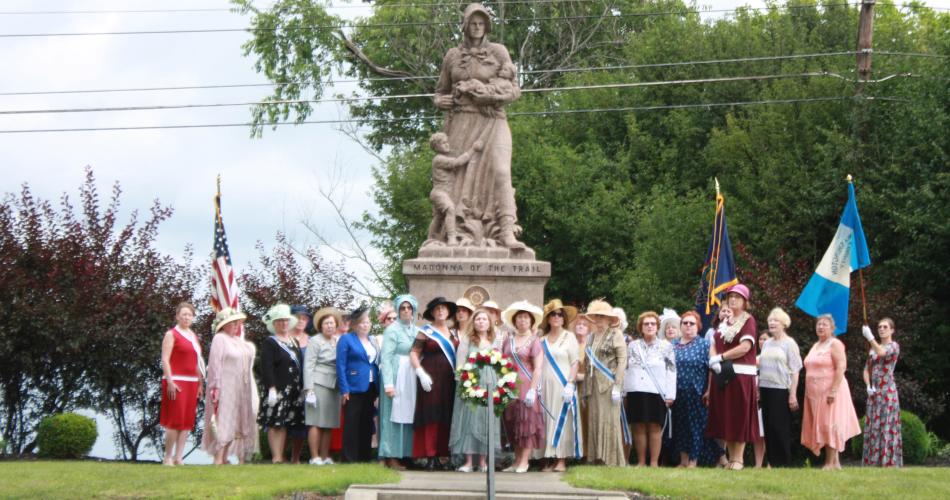

A Monumental Visit with the Pennsylvania Daughters

Denise Doring VanBuren, President General

It’s a story of epic proportions: millions of westward pioneers, a 3,000-mile highway, a future U.S. President, the unshakable resolve of the indomitable 1920s Daughters -- and 12 monumental women who weigh a combined 240 TONS!  

This weekend, I finally got an “up close and personal” visit to one of our National Society’s most enduring projects, with a visit to Beallsville, Penn. More than 50 Daughters came to honor the spirit of our pioneer mothers at one of the legendary Madonna of the Trail statues as part of a 1920s-themed fundraising luncheon to support the maintenance and upkeep of their local statue.

View a video slideshow here.

I’ve always been fascinated by the idea that these early DAR members realized the importance of celebrating the courage and stamina of the female pioneers, stories that were often left out of traditional accounts. While I have been wanting to visit one in person since I joined the DAR back in 1988, the story of their creation begins much earlier and requires some detail.

In 1911, our National Society created the National Old Trails Road Committee, with a purpose to establish the Old Trail Road – which included the Sante Fe Trail, the Oregon Trail, the Natchez Trace, the Braddock Trail and the Cumberland Route, all pathways that had brought Americans west to settle our nation -- as a National Memorial Highway. In large part due to the work of DAR members, the National Old Trails Road Association was founded in 1912 with a mission to “assist the Daughters of the American Revolution in marking Old Trails and to promote the construction of an Ocean-to-Ocean Highway of modern type worthy of its memorial character.” World War I, however, strained capital resources, and the project stalled.

But our National Society renewed its efforts by appointing Missouri Daughter Arline Nichols Moss to head the effort in 1924. Under her leadership, a prior suggestion to erect 3,096 individual mile markers for the project was replaced with a plan to instead erect one marker of “dignified” proportions in each of the 12 states through which the Old Trails Road passed all the way from Maryland to California. (Much of the route ultimately became Routes 40 and 66.)

It was Mrs. Moss who proposed that the statues honor the brave spirit of the women who boldly crossed the continent. Sculptor August Lembach of St. Louis was hired to design the statues, which were to feature a woman clasping her baby in one hand and a rifle in the other, while her young son clings to her skirt. Each statue would stand 10 feet high on a six-foot base with a two-foot foundation, creating a monument 18 feet tall that weighs nearly 20 tons.

In 1926, future President Harry S. Truman was named president of the National Old Trails Road Association. Truman periodically drove the National Old Trails Road from coast to coast and met with members of the association in each state to discuss improvement of their segments. In fact, Truman's name would remain listed as “president” on the letterhead of the National Old Trails Road Association well into the late 1940s.

Truman himself worked with Mrs. Moss and local officials to select the 12 locations for the pioneer mother statues to be placed along the route. The first Madonna was dedicated in Springfield, Ohio, on July 4, 1928, and the remaining 11 were all formally dedicated within the ensuing nine months. The Washington County, Penn., Madonna was dedicated on a cold and blustery Dec. 8, 1928, with President General Grace Brousseau (pictured at center holding a bouquet) and Mrs. Moss in attendance. The most recent President General to have visited the Pennsylvania Madonna was Marie Hirst Yochim in 1990.

The front panel of each base reads “The Madonna of the Trail. NSDAR Memorial to the Pioneer Mothers of the Covered Wagon Days.” The rear states “The National Old Trails Road.” Each statue also includes side panels that provide for a 25-word inscription denoting the historic event that occurred at the place of its specific location. Missouri granite is the most common aggregate in the statues, creating their warm, pinkish shade. 

The cost for this monumental undertaking? The NSDAR contributed $12,000 for the creation of the actual statues, for which each member was asked to contribute 10 cents! The National Old Trails Association and local authorities bore the cost for freight and placement, creating a total estimated project cost of $70,000 (which translates to approximately $1.2 million in today’s money). And, of course, much more has been invested in the monuments since their placement 93 years ago.

Wondering where all of these markers are located? In a line that stretches from Bethesda, Md; across to Washington County, Penn.; then on to Wheeling, W. Va.; Springfield, Ohio; Richmond, Ind.; Vandalia, Ill.; Lexington, Mo.; Council Grove, Kan.; Lamar, Colo.; Albuquerque, NM.; Springerville, Ariz.; and ends in Upland, Calif. (It is my hope that we will leave a similar legacy through a coast-to-coast network of markers honoring the Patriots of the American Revolution as a result of our ongoing America 250 effort. Find more about that project here.)

I am extremely grateful to Pennsylvania Daughter Rebecca Braun, who serves as the chair of her state’s Madonna of the Trail Committee and who hosted the outstanding luncheon and ceremony that followed, for her passionate support of Pennsylvania’s pioneer mother. It was especially fun to dress in the 1920s fashions to honor the long-ago members who carried this project to completion. And I am deeply grateful to Pennsylvania State Regent Elizabeth Watkins for so graciously including me in this and several other commemorative events here in the Keystone State. These women may not stand quite as tall as their Madonna, but their dedication, kindness and hospitality are as equally epic!

send-a-commentSend Us a comment