
Honoring the Life of L’Enfant

Denise Doring VanBuren, President General

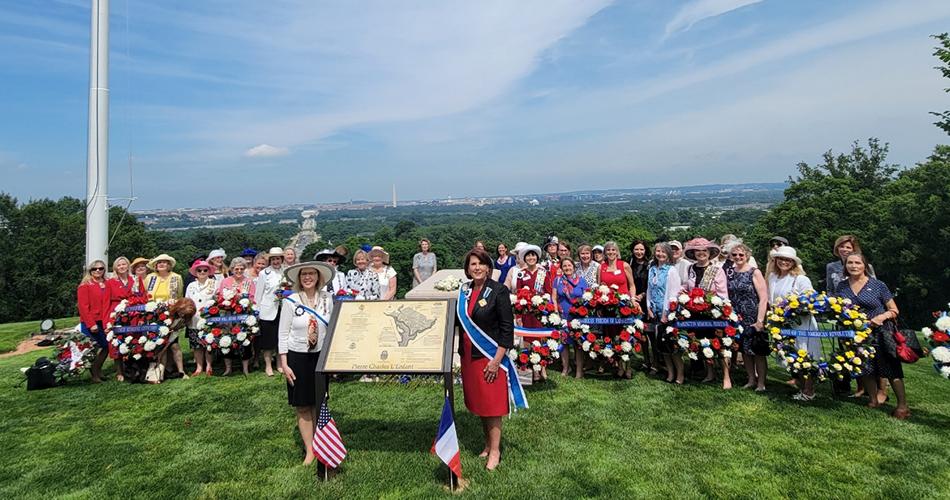
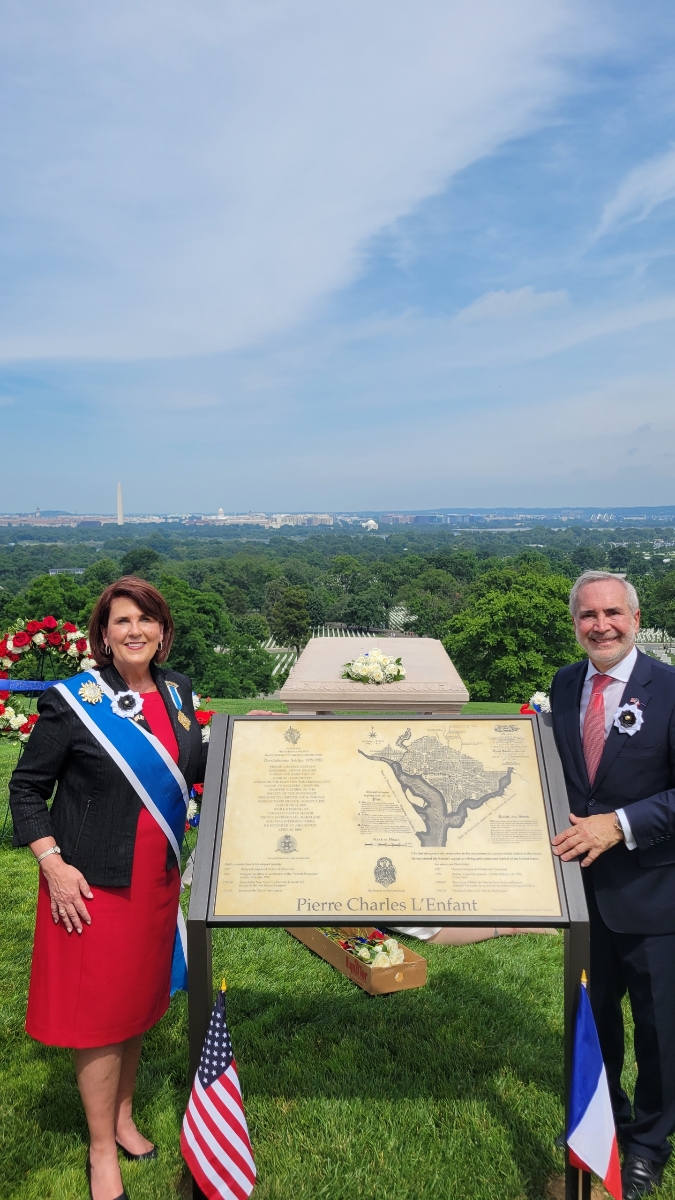
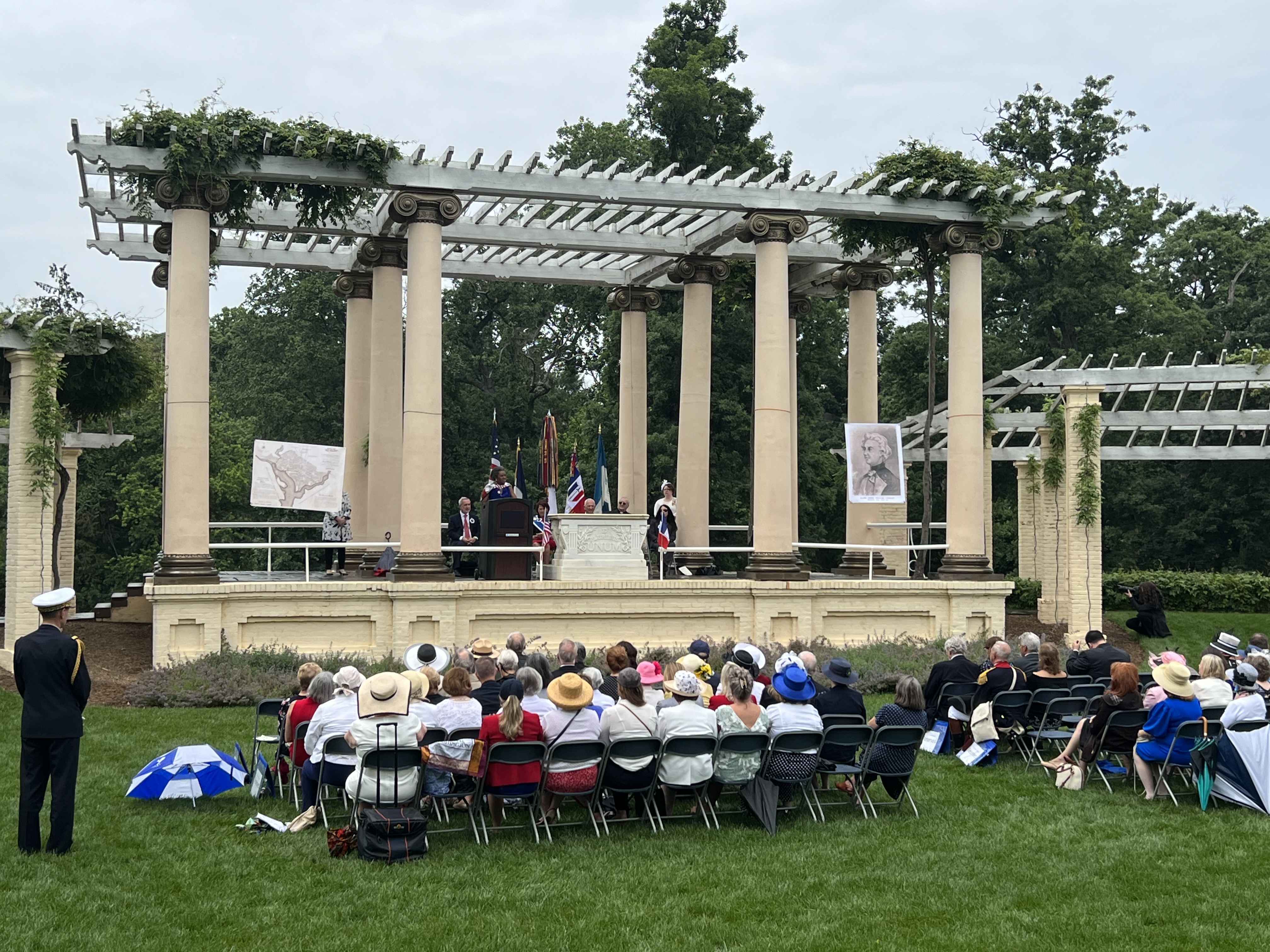
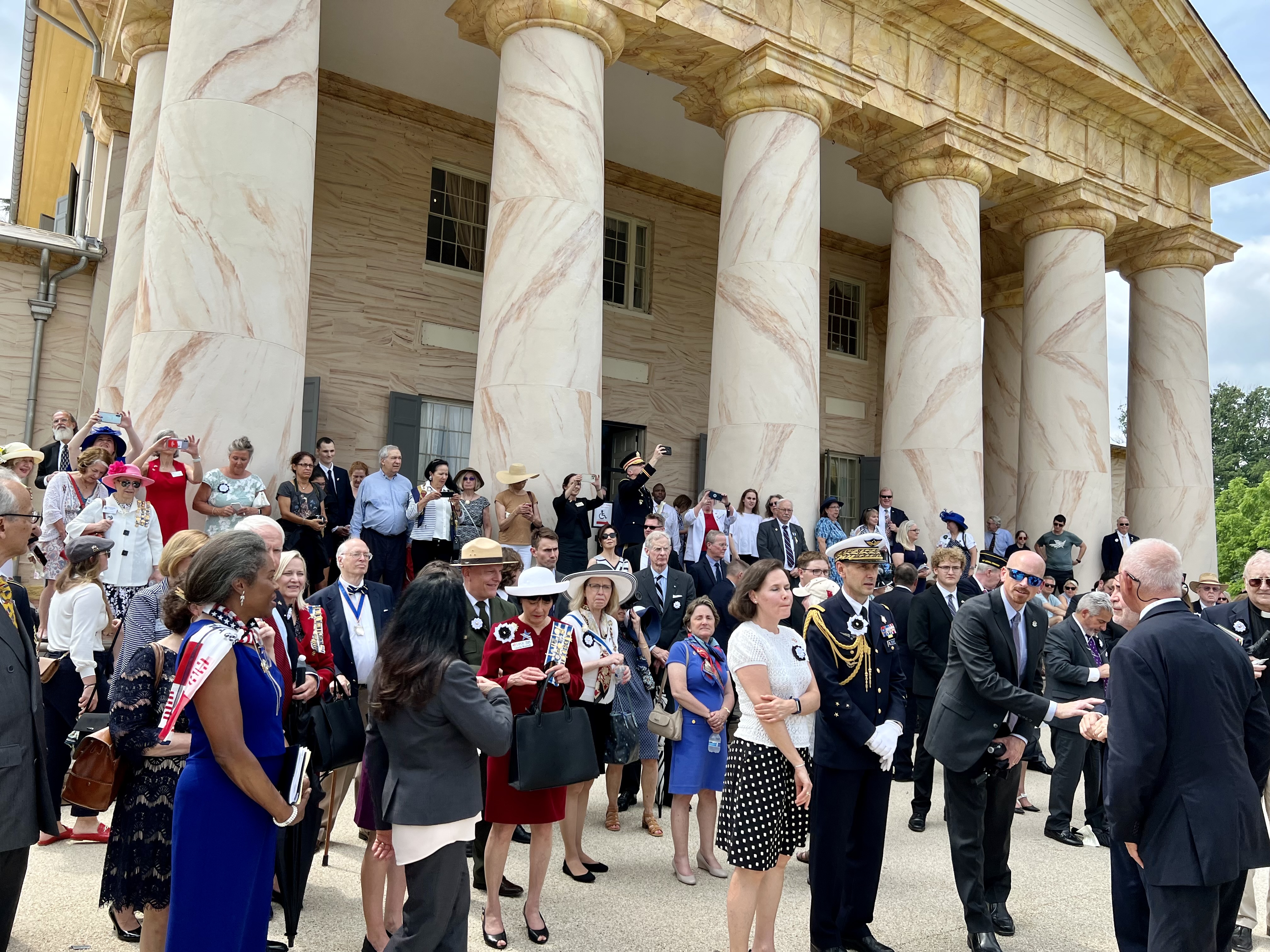
In 1995, our National Society joined the American Society of Le Souvenir Francais to create and erect an interpretive sign at Arlington National Cemetery above the final resting place of Pierre Charles L’Enfant, Revolutionary War Patriot and designer of our nation’s capital. Several months ago, I was contacted by Thierry Chaunu, president of the group, who inquired if I would be interested in replacing the sign, which had been removed during recent construction. Of course I said “oui!” It was an honor to join with Mr. Chaunu and more than 200 supporters to dedicate the new marker yesterday, as June 14 was the anniversary of L’Enfant’s death in 1825.

Le Souvenir Francais has an official mission to: “honor and preserve the memory of French soldiers, sailors and airmen who gave their lives for freedom, and who are buried in the United States; promote the appreciation for French culture and heritage in the United States, and the ideals that unite our two nations; and strengthen the historic long-standing bonds of friendship since 1778 between the American and French peoples, and to this end erect or maintain memorials and monuments and encourage historical research, public presentations and publications in the media.”

Tuesday’s ceremony accomplished all this – and it was a pleasure to work with Mr. Chaunu to complete this undertaking. Among others who participated in our shared ceremony were: Virginia Lt. Governor Winsome Sears; Deputy Ambassador to France Aurelie Bonal; Arlington National Cemetery Superintendent Ray Alexander; Executive Director of Army Cemeteries  Karen Durham-Aguilera; Military Women’s Memorial President Phyllis Wilson; Society of the Honor Guard Tomb of the Unknown Soldier Co-Founder Richard Azzaro; and representatives of a dozen patriotic and fraternal organizations. I am grateful to Virginia State Regent LeAnn Turbyfill for joining us, as well as dozens of local Daughters, especially the members of the Cameron Parish Chapter, who created stunning lapel cockades as the ceremony keepsake for dignitaries. Virginia Daughter Sharla Rausch served splendidly behind the scenes as our point person and coordinated Pages and other important details. Thank you, ladies!

Aspiring architect Pierre L'Enfant arrived along the Potomac in 1791, determined to carve his concept of a Federal City from a swampy wilderness. L’Enfant imagined a grand capital of wide avenues, public squares and impressive buildings on a grid of streets intersected by long, diagonal avenues to shorten travel between federal buildings. It would be a capital fitting for a new nation conceived in liberty. The centerpiece of his plan would be the National Mall that stretches for two miles, from Capitol Hill to the Potomac River. Indeed, L’Enfant’s vision was grand – and his resulting legacy established our nation’s capital as one of the most beautiful in the world.

Yet, while many will recognize his name, many more his masterpiece of urban design, few know that L’Enfant’s initial contributions to our nation occurred more than a decade earlier – when he came to the aid of the fledgling American nation as we fought for our independence from the mighty British empire.

L’Enfant was born in Paris on August 2, 1753. He was recruited by Pierre Caron de Beaumarchais to join the American cause. An early French supporter of American independence, Beaumarchais lobbied the French government on behalf of the American rebels and oversaw covert aid from the French and Spanish governments in the years before their formal entry into the war. With the support and endorsement of the powerful and influential Beaumarchais, L'Enfant arrived in America in 1777 at the age of just 23, having completed his studies at the Royal Academy of Painting and Sculpture in Paris.

L'Enfant received a commission as captain of engineers during the grueling Valley Forge winter in 1778. While with Washington at Valley Forge, the Marquis de Lafayette commissioned L'Enfant to paint a portrait of the Commander in Chief.

But L’Enfant soon grew dissatisfied with technical roles as engineer and artist and petitioned to go south in hopes of distinguishing himself in combat. In 1779, he fought at Savannah, Georgia, and was badly wounded in the leg. He rejoined the army by 1780, and fought while leaning on a crutch during the Siege of Charleston, South Carolina. Taken prisoner with the rest of the Charleston garrison in 1780, L’Enfant was therefore unable to participate in the Siege of Yorktown in 1781. L'Enfant would forevermore believe that he had missed his chance for glory and promotion at Yorktown.

After release as a prisoner of war, L’Enfant returned to the Continental Army. He sought and received a promotion from Washington and then moved with the army to the Hudson Highlands in the spring of 1782. A year later, L'Enfant was promoted to Major of Engineers in recognition of his service. When the Continental Army disbanded in December of 1783, L’Enfant was honorably discharged; and after a return visit to France to care for his ailing father, he returned to stay in the U.S. as an architect.

He would be hired to transform New York’s City Hall, enlarging and redesigning it to serve as America’s new seat of power. It became the first example of Federal Style architecture under the Constitution and was renamed Federal Hall. It hosted the 1st Congress and became the location where George Washington took the oath of office as America’s first President on April 30, 1789. For this design, L’Enfant was offered - and accepted - honorary U.S. citizenship. In addition to other designs and commissions, he served as a professor of engineering at the United States Military Academy at West Point from 1813-1817. 

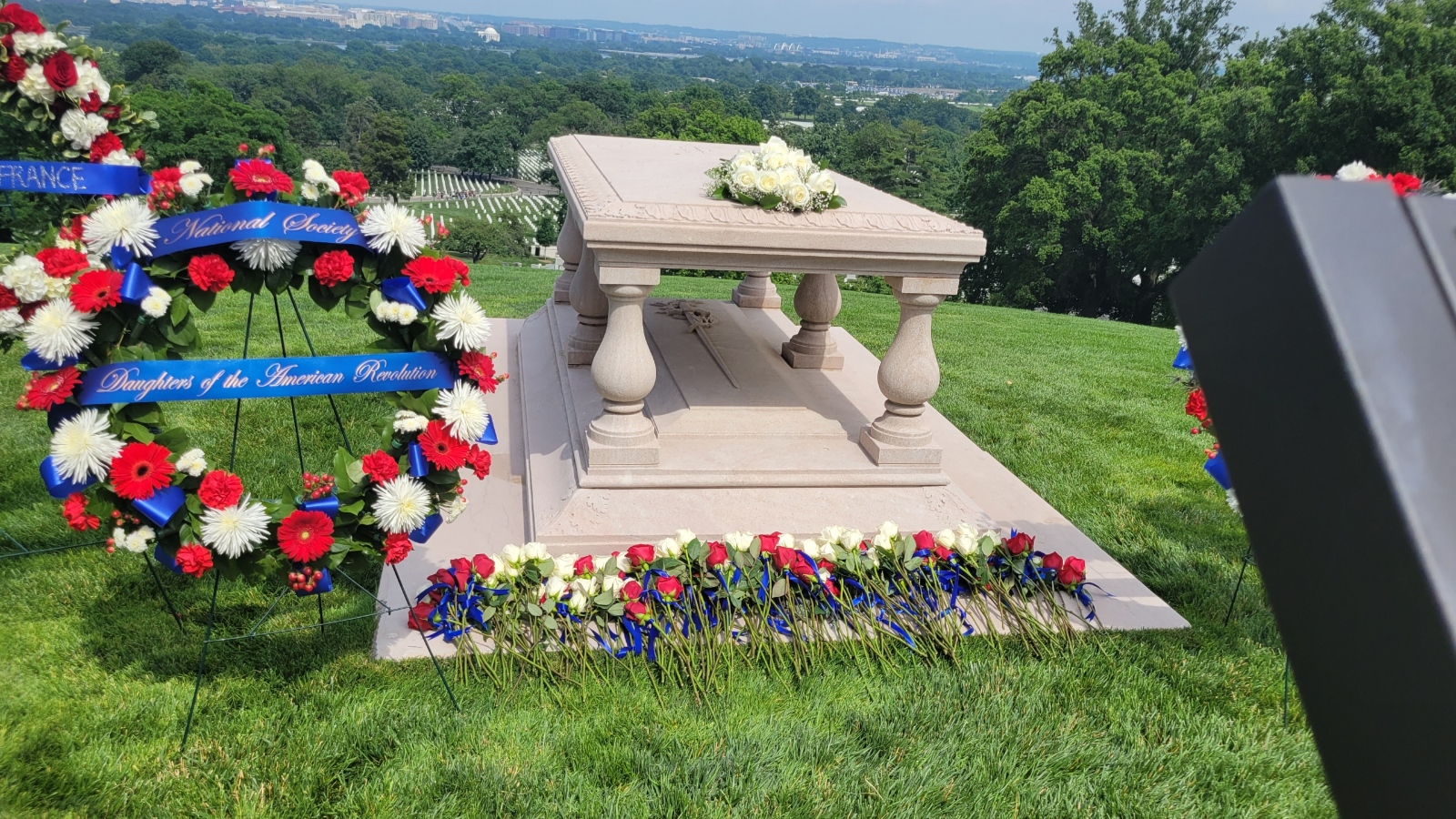
Plagued by financial troubles his entire life, L’Enfant died destitute at the age of 71 on June 14, 1825. His grave in Prince George’s County, Maryland, was obscure and unmarked. It was said that no one attended his funeral and he was buried unceremoniously. Eventually his contributions to America’s capital were recognized and actions taken to honor him. In 1908, $1,000 was allocated to exhume his remains. He lay in state at the Capitol rotunda, the only foreign-born individual to ever be so honored.

Pierre Charles L’Enfant was re-interred at Arlington on April 28, 1909, in the presence of a large crowd that included President William Howard Taft. A newspaper report described the ceremony as follows:

“Around noon eight army engineers carried L’Enfant’s casket out to the east front of the Capitol and set it on an artillery caisson pulled by six bay mares. Cavalry from Fort Myer led the way, followed by the Corps of Engineers band. A cortege of five hundred people, sometimes outnumbering the crowds flanking them, began its procession up Pennsylvania Avenue and across the Rock Creek bridge to M Street, reversing the direction of L’Enfant’s original ride around the site. Flags flew at half-mast all along the way.”

L’Enfant’s re-burial at Arlington allowed him to rest in peace and dignity -- and for a grateful nation to acknowledge his visionary plan of a “Federal City” that would come to properly represent the great nation envisioned by its founders – his fellow Patriots. Fittingly, his gravesite overlooks the portion of Washington, D.C., that he originally designed. May we never forget the contributions of Pierre L’Enfant to our nation during its critical formative years – and may we hope that the reproduced signage unveiled on Tuesday will help to ensure that future generations will do the same.

send-a-commentSend Us a comment