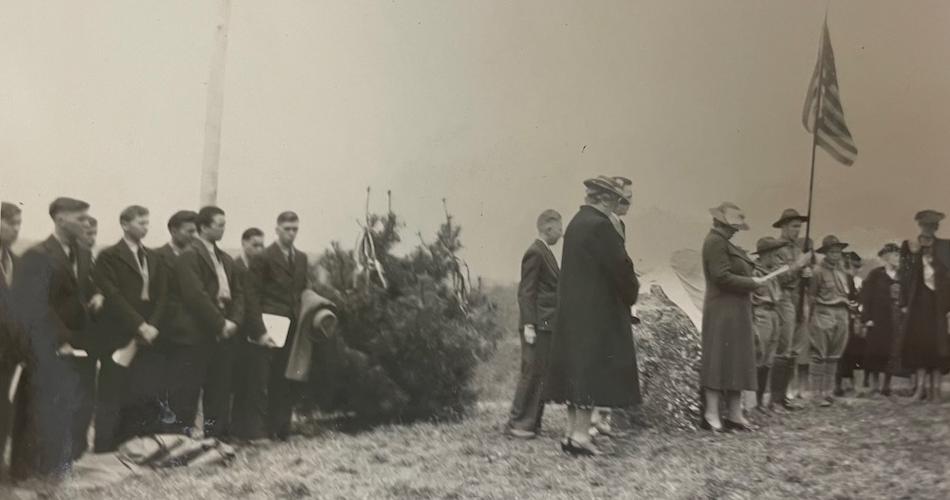

DAR’s National Forests, Yesterday and Today

Denise Doring VanBuren, President General

In 1939, then Chief of the U.S. Forest Service, F.A. Silcox, wrote the following in his annual report, about forests: “But although we still have enough forest land, we need on it more and better forests. For they will help provide more jobs and steadier ones. They will in this and many other ways help underwrite a permanent and more prosperous civilization.”

As we often have throughout history, DAR members heeded the call to action. In 1939, under the leadership of President General Sarah Corbin Robert, DAR endeavored to help protect the future of America’s forests with the DAR Forests project. At the time, it was referred to as the Penny Pines Project, after the rough cost of each seedling – one cent - in proportion to the price of each acre of land.

This project, which was Golden Jubilee national project under Mrs. Robert, was a collaboration with the US Forest Service, state forest authorities, and President Roosevelt’s Civilian Conservation Corps (CCC). Under it, each chapter was to plant one acre of seedlings on state and federal lands between 1939 and 1941. Many of these forests were planted in memory of passed Daughters and Patriots.

Chapters pledged the funds for each acre and members of the CCC did the actual physical planting. The CCC itself was created in 1933 to alleviate massive unemployment facing young American men during the Depression, and to help maintain and preserve the nation’s natural resources. By the time of the 50th Continental Congress in 1941, DAR’s goal for the project had already been surpassed by 150 acres, or 1,500,000 trees. “To every member of the Conservation Committee, this is a time of real 'jubilation,'" reads the report from the 50th Congress, describing the achievement.

Today, DAR Forests can be found in every corner of the country, beautiful additions to its heritage of conservation and celebration of our natural resources. Despite the original “Penny Pines” name, the forests feature an array of native trees alongside pines – ash in Illinois, redbuds in Oklahoma, cedars in Virginia, and more. Some DAR forests feature recreation opportunities to the public, from campgrounds to trails to boating. Many are marked by plaques and signs maintained by today’s Daughters, along with the forests themselves.

Here is a selection of just some of the DAR Forests across the country, some dating back to the original 1939-1941 project, and others established much more recently. You can learn more about DAR Forests around the country here. I encourage you to visit your local DAR forest and appreciate the efforts of our past and present members in growing America’s natural beauty.

  • Georgia: The 100 acre Richmond Walton McCurry Memorial Forest in the Chattahoochee-Oconee National Forest was planted in 1940, with 231,650 shortleaf pines.
  • Idaho: In 2012, after the Trinity Ridge fire consumed over 140,000 acres of forest in central Idaho, the Idaho State Society helped reforest with the purchase of 2,000 native white bark pine seedlings.
  • Illinois: By the 50th Congress in 1940, Illinois had the largest forest with over 1000 acres of land. Short leaf and pitch pine, gray ash, black walnut, and black locust trees were planted on what was formerly barren, deforested land. The site is in the Shawnee National Forest in southern Illinois.
  • Massachusetts: The 1517 acre DAR state forest is located in the Berkshire foothills of Western Massachusetts and contains miles of campgrounds and trails. The local Daughters visit the forest yearly and provide financial support for its maintenance.
  • Nebraska: The state’s only National Forest, located in central Nebraska, features 47 acres of penny pines. It is located the middle of sand hills and is surrounded by cactus and yucca plants. In 2009, Daughters planted 255 pine seedlings to expand the forest.
  • Wyoming: The DAR Forest in Wyoming was established in 2015 to celebrate NSDAR’s 125th anniversary and Wyoming’s 125th anniversary of statehood. In celebration, 500 white bark pine trees were planted as part of an effort to reforest 24,00 acres that had burned in a fire in 2006.

send-a-commentSend Us a comment