
Remembering Our Patriots at Fort Ticonderoga

Denise Doring VanBuren, President General

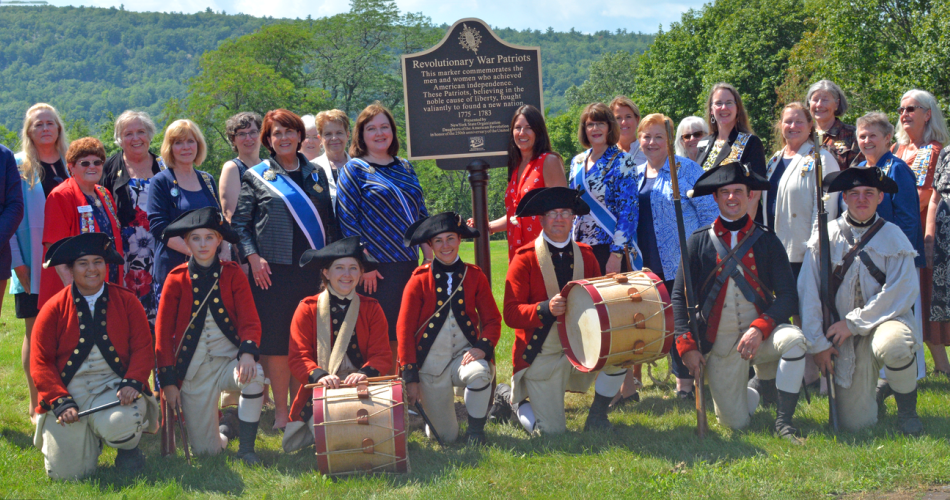
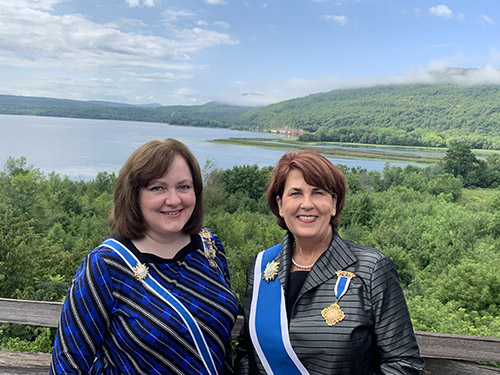
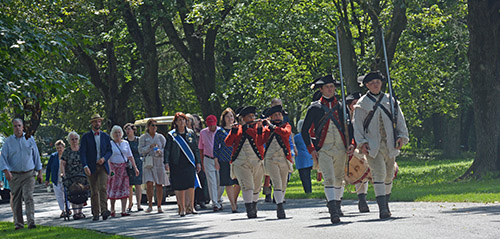
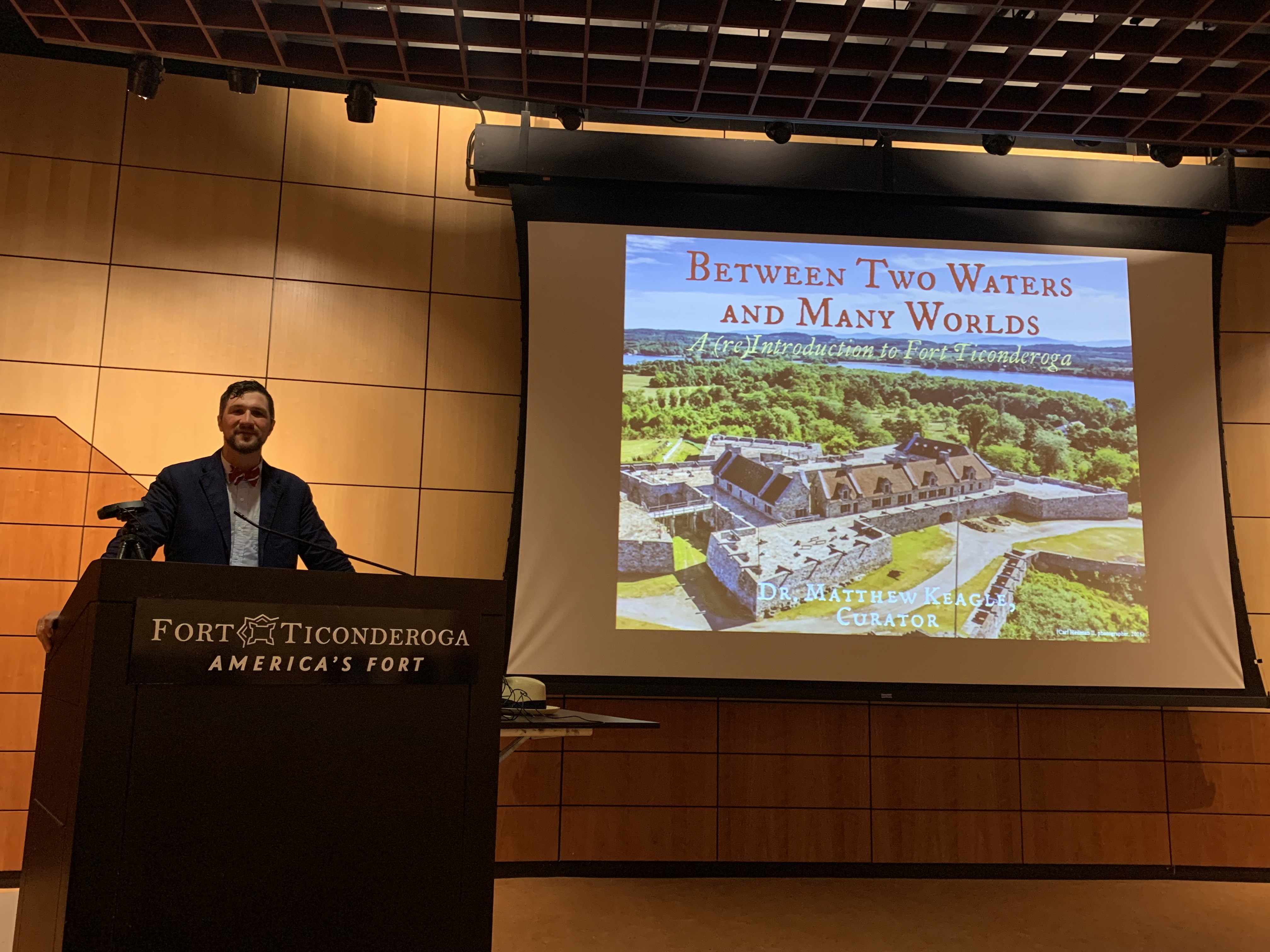
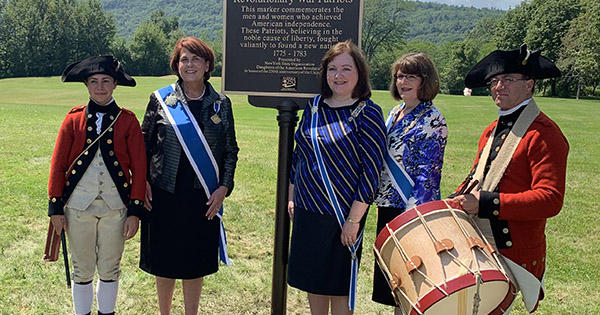
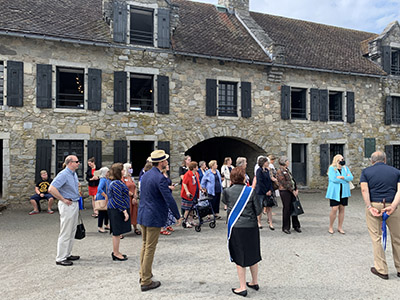
An important Revolutionary War battle site and tourist attraction now contains a beautiful new DAR America 250 Patriots Marker that honors the men and women who helped to achieve American independence there and elsewhere. I thank and congratulate New York State Regent Patrice Birner for working successfully with the private organization that runs Fort Ticonderoga to place and dedicate the impressive marker during ceremonies held on August 24. Historian General Laura Kessler and I were simply delighted to attend the events, which included a tour of the reconstructed stone fort, a lecture about its historic significance, a delicious luncheon and the meaningful dedication.

Located on Lake Champlain just north of Lake George, Fort Ticonderoga served as a point of access to both Canada and the Hudson River Valley during the French and Indian War – and saw more fighting than any other site during that conflict. It contained three barracks and four storehouses, with one bastion that held a bakery capable of producing 60 loaves of bread a day.
Owing to its size and location, it’s little wonder that it became a key focus of the American Revolution as well. On May 10, 1775, Benedict Arnold joined Ethan Allen and the Green Mountain Boys of Vermont in a dawn attack on the fort, surprising and capturing the sleeping British garrison that numbered just 48 men. Allen is claimed to have said, "Come out, you old Rat!" to the fort's British commander. It was also later said that he demanded that the British commander surrender the fort "In the name of the Great Jehovah and the Continental Congress!" While these details may be apocryphal, they illustrate the near-mythical role this site would play in the consciousness of the new nation.

Although it was a small-scale conflict, the Battle of Fort Ticonderoga was an early American victory of the Revolutionary War, and would give the Continental Army much-needed artillery to be used in future battles. Arnold remained in control of the fort until 1,000 Connecticut troops arrived in June 1775.

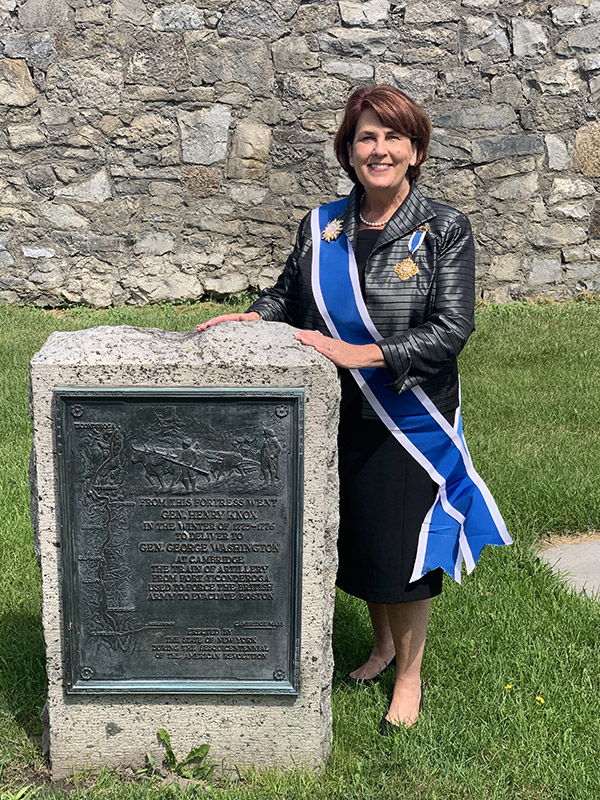
The name "Ticonderoga" was derived from an Iroquois word meaning "between two waters," or "where the waters meet." With its seizure, the Patriots gained a large supply of cannons and other armaments, much of which Henry Knox would shortly transport to conduct the siege of Boston, which forced the British to evacuate that city in March 1776. Ticonderoga was also used as a staging area for the invasion of Quebec.

In May 1776, British troops began to arrive at Quebec City, where they broke the Continental Army's siege. The British chased the American forces back to Ticonderoga in June and destroyed a small fleet of American gunboats in the Battle of Valcour Island in mid-October; but with snow already falling, the British retreated to winter quarters in Quebec. About 1,700 troops from the Continental Army, under the command of Colonel Anthony Wayne, wintered at Ticonderoga. Wayne left Ticonderoga in April 1777 to join Washington's army; he reported to Washington that "all was well," and that the fort "can never be carried, without much loss of blood."

Yet by June, General Burgoyne led 7,800 British and Hessian forces south from Quebec. After capturing nearby Fort Crown Point without opposition on June 30, he prepared to besiege Ticonderoga.  Burgoyne realized the tactical advantage of the high ground and placed his cannons atop nearby Mount Defiance. Faced with bombardment from the heights (although no shots had yet been fired), General Arthur St. Clair ordered Ticonderoga abandoned on July 5, 1777. News of the abandonment of the "Impregnable Bastion" without a fight, caused "the greatest surprise and alarm" throughout the colonies. After public outcry over his actions, St. Clair was court-martialed in 1778; he was cleared on all charges.

In addition to the warfare that occurred here, the site is an excellent example of historic preservation. In 1785, its lands became the property of the state of New York, which donated it to Columbia and Union colleges. The colleges sold the property to William Ferris Pell in 1820; he first used the property as a summer retreat but soon converted his house into a hotel to serve the tourist trade.  

The Pell family also hired an English architect to restore the fort and formally opened it to the public in 1909 as an historic site. The ceremonies, which commemorated the 300th anniversary of the discovery of Lake Champlain by European explorers, were attended by President William Howard Taft. The fort was even re-armed with 14 cannons provided by the British government – they had been cast in England for use during the American Revolution, but the war ended before they were shipped over!

In 1931, descendant Stephen Hyatt Pell founded the non-profit Fort Ticonderoga Association, which remains responsible for the fort’s operation.  Fort Ticonderoga was placed on a watchlist of National Historic Landmarks in 1998 because of the poor condition of some of the walls. But it has experienced a renaissance thanks to current volunteer leadership, community support and professional staff. For example, in 2008, the powder magazine, destroyed by the French in 1759, was reconstructed, based on the original 1755 plans, to create an education center.

And it is flourishing with wider worldwide accessibility thanks to the internet. Read more about its innovative digital history lessons here. And next month, it will sponsor its annual symposium on the Revolutionary War.

Today, the site welcomes 75,000 visitors annually – preserving the story of the Revolutionary War events that occurred here – and the men who fought here, thanks in part, to a new marker from the New York State Organization of the Daughters of the American Revolution. Huzzah!

(Postscript: Nearly 30 DAR America 250 Patriots Markers have now been approved; it is the goal of the National Society to place at least one in every state in anticipation of the nation’s Semiquincentennial. Learn how you, your chapter or state may do so here.)

send-a-commentSend Us a comment