
Textile Research at Home

Alden O'Brien, DAR Museum Curator of Costumes and Textiles

You might imagine that curators spend all their time in storage with “our” beloved objects, but as much as we love our time with the collection, the truth is that most of our work is done at our desks, with forays into storage as needed. So when lockdown began, and the Information Systems team prepared us to access our DAR desktops from home, we were able to adjust smoothly and keep doing almost everything we normally do. 

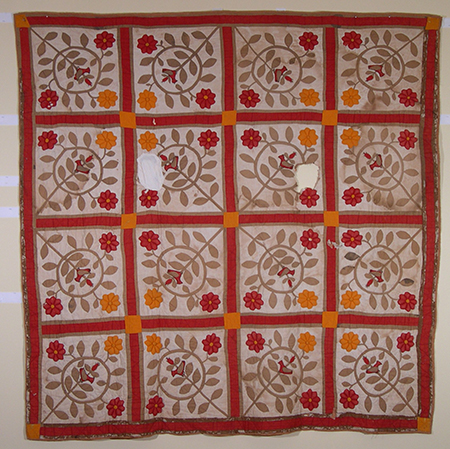
One of our priorities in the last few years has been to get the DAR Museum collection “live” online, searchable by anyone at our online database. Since the building closed in March, I’ve added over 100 quilts, a dozen samplers (in addition to doing deeper genealogy research on several dozen more which were already “live”), and about 100 costume items to the online collections.

While only 25% of employees can be on-site at the moment, we are able to arrange access as needed. Since the building partially reopened, I’ve been able to return to storage periodically to take more photos and measurements and notes on garments so I can work on their cataloging descriptions at home. Nothing can stop an object-loving curator from working with “her” objects!
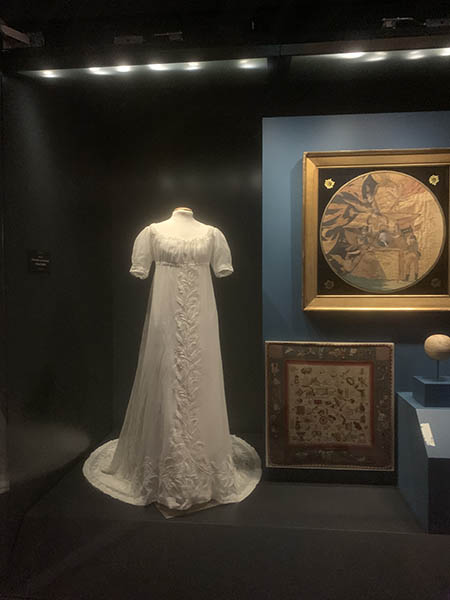
I also returned to storage to dress a manikin in a white muslin dress we have lent to the Museum of the American Revolution in Philadelphia. After setting the manikin up with the right amount of padding and an underdress correct for the period, I carefully packed the dress in an acid-free box and brought manikin and box to Philadelphia, re-dressed the manikin, and supervised its installation in the designated glass case at the Museum. The dress is part of the Museum’s exhibit When Women Lost the Vote: A Revolutionary Story, 1776 – 1807, learn more about a DAR grant that supported the exhibit here.

Lockdown offered the time to delve more deeply into many of these textiles. Family history mysteries have been probed and solved. Donor histories’ gaps have been filled. Quilt and sampler makers’ biographies have been fleshed out.

As an example, a Scottish sampler in the collection had the maker, Mary Horsburgh tentatively associated with a birth record in Perthshire, but the many initials included were unidentified. Since Olive Graffam, previous curator of the samplers, first cataloged the sampler, many more genealogy databases from the UK have been put online. Through birth and marriage records, I was able to confirm the maker by identifying the initials which belonged to her siblings, parents, grandparents, and her many aunts and uncles. Relations who were deceased when she was sewing, had initials done in black thread. Intriguingly, the women were represented with their maiden initials (which helped confirm everyone’s identity, instead of having everyone with the same last initial!). 

One of our quilts was given with the maker identified as “Doctor Hornsby’s wife.” The donor was from Louisiana. We had never had the time needed to pursue these tiny clues. But this spring, I was eventually able to find the only Dr. Hornsby in Louisiana and identify his wife as Almira Crossgrove who married Samuel Hornsby in 1859 in Concordia, Louisiana and divided her time between Louisiana and nearby Natchez, Mississippi. That record is now online, although taking a photo of it that shows it since being conserved will have to wait.

Knowing who made or owned our objects is one of the biggest strengths of our collection. Our quilts and samplers are made by the many “well-behaved women” who “seldom make history.” To be able to honor the maker of one of these artworks by giving her a name is deeply satisfying.

Another silver lining to this year has been the explosion of educational programs offered by museums and universities everywhere, via Zoom. I have been able to “attend” numerous lectures by colleagues doing ground-breaking research in the UK as well as the throughout the US, which I’d never be able to follow before they started using Zoom. And I have myself given four lectures virtually, which have reached several hundred listeners from as far away as Hawaii, Canada, Texas, the UK, and even Australia. These “attendees” would never have been able to come to the DAR Museum in person, but if they did not know us before, they know about us and our collections now and can explore them online in our virtual tours and online database. 

We look forward to truly “turning a corner” on the current situation and being able to safely return to DAR Headquarters. In the meantime, however, we have continued to work effectively to further the goals of the DAR Museum and of DAR.

send-a-commentSend Us a comment