
Tales from the Archives: Continental Congress Changes During WWII

Amanda Fulcher Vasquez, DAR Archivist and Digital Asset Specialist

Many plans have changed as a result of the Coronavirus pandemic. This includes conducting DAR’s Continental Congress virtually this year rather than in-person at DAR Headquarters in Washington, D.C. This is not the first time that the DAR Congress has been altered because of a national emergency. During World War II, Congress was held away from Washington, D.C. four times and canceled in 1945, as the United States was faced with many rations and restrictions to support the war effort. For example, meat and gasoline sales were rationed, and the production of many goods were banned while manufacturers focused on producing military supplies and equipment. The changes to Continental Congress helped support the war effort.

On March 12, 1942, a little more than a month prior to the planned April Continental Congress, President General Helena Pouch informed DAR members that Congress would be moved to May 4 at the Stevens Hotel in Chicago, Illinois. The National Board of Management voted in favor of this change and President General Pouch urged the DAR membership, “Your patriotic cooperation is requested in this unprecedented and difficult rearrangement of Congress plans. Let us make of our Congress a demonstration of our earnestness to assist our Government in united war effort.”

President General Pouch would later state, “Some might gain the impression, because of our D. A. R. Congress in Chicago, that we were asked to move from Washington. Let it be said that this move was entirely voluntary on the part of our members and taken after careful deliberation. When it became apparent that our presence in what is now the war capital of the world would further complicate the terrific congestion already existing there, it was decided that our cooperation in this crisis was necessary.” When addressing the more than 4,000 members in the audience of the Chicago Congress, President General Pouch called this meeting the “Victory Congress.” During course of this meeting, projects that supported the war effort were discussed and several committees that supported these projects were approved.

DAR would go on to hold three additional war time annual meetings away from DAR Headquarters. The 52nd Continental Congress was held in April 1943 in Cincinnati’s Taft Auditorium of the Netherland Plaza. President General Pouch addressed the DAR membership at Congress, praising them for their support of the war and declared, “This is a War Projects meeting. We now face greater sacrifices.” Her speech went on to address the need to expand the blood plasma collection program and to purchase more war bonds. Prior to the start of the 52nd Continental Congress, President Franklin Delano Roosevelt sent the DAR a letter of greetings. He told the DAR membership that, “in a profound sense it is a woman’s war.”  He concluded, “I am confident that organizations like the Daughters of the American Revolution will take the lead in helping mobilize the womanpower of America in defense of their democratic heritage.”

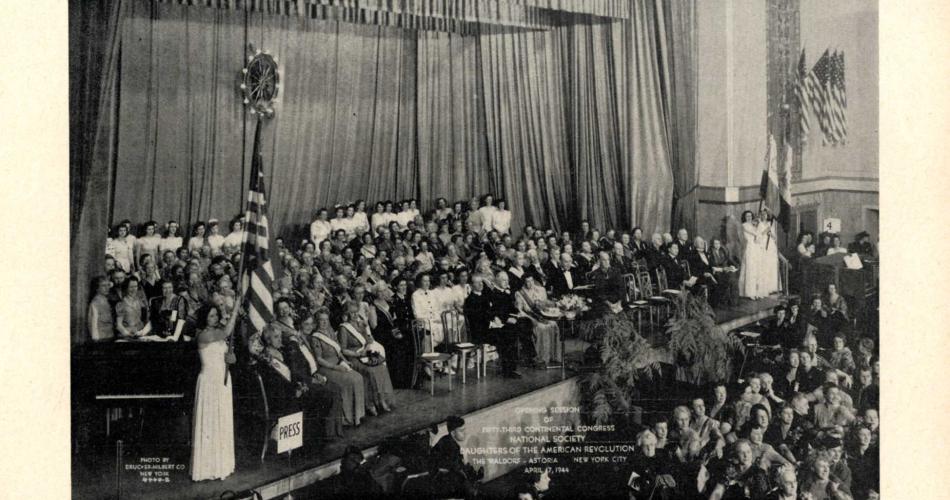
The following year, the 53rd Continental Congress was held in New York City. On April 17, 1944, Opening Night was held at the Waldorf Astoria and letters of greetings from President Franklin Roosevelt and New York Governor Thomas Dewey were read to the audience. The remainder of the events were held at the Commodore Hotel. Once more, the DAR membership spent their annual meeting discussing national war projects, such as providing plasma trucks and war bonds. DAR and President General Pouch received a special citation from the U.S. Treasury Department for bonds totaling more than $1 million sold between Pearl Harbor and the 1944 Congress. May Erwin Talmadge was elected the 19th President General of the DAR.

As wartime restrictions grew, Americans were urged to “Do with less – so they would have enough.” During 1945 restrictions on civilian activities, such as travel, were at their peak and consequently the 54th Continental Congress was canceled. In a February 6, 1945 letter, President General May Talmadge wrote, “Almost immediately following the request of the Office of Defense Transportation to all organizations to call off their annual meetings, I assured that office that the National Society, D. A. R. would comply with their request and would cooperate in every way. The Executive Committee was consulted immediately with 100% agreement on that point. The National Board of Management at their meeting on February 1, fortified by advice of the Parliamentarian and the Attorney, officially and unanimously voted to cancel the 54th Continental Congress, which was scheduled to convene in Chicago, April 16-19, 1945.”

In the March 1945 she would go on to say, “It will be a disappointment—but not a hardship—for no sacrifice is too great for the D. A. R. Society to make, if it means added comfort and convenience to our service men traveling to and from their line of duty. ” National Officers, National Chairs and State Regents were able to deliver their annual reports, when President General Tallmadge held an extended National Board of Management Meeting in April 1945 to ensure that DAR business would prevail.  

World War II ended in September 1945, and one more time DAR would hold the 55th Continental Congress away from DAR Headquarters. In May 1946, Congress was held at the Marlboro Blenheim Hotel in Atlantic City. During her address during the Opening Session, President General Talmadge told fellow members, “The task of rebuilding awaits. We are strong. Let us go forward in our aim together—and GOD BLESS YOU IN EVERY STEP.” The following year Continental Congress would be held back at DAR Headquarters.

send-a-commentSend Us a comment